From Spikes to Song: Modeling the Song Control System
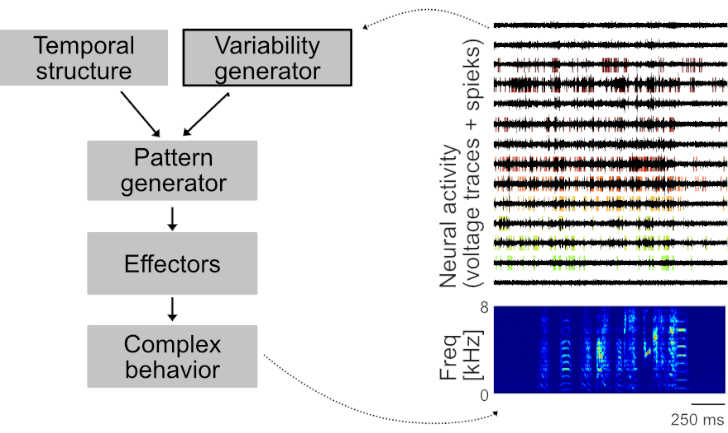
Figure 1. Model circuitry and brain recordings. Left: Simplified songbird motor control system. Right: Neural activity during singing in the variability generating premotor pathway.
Research context
Songbirds produce learned vocalizations using a well-characterized neural circuit involving the premotor areas HVC and LMAN which both innervate the motor area RA. While the HVC→RA pathway generates highly stereotyped song patterns, input from LMAN onto RA introduces variability that is essential for learning and adaptation. How this variability arises from neural activity — and how it is transformed into structured motor output — remains an open question.
Project description
In this project, we aim to model the song control system by extending a simplified HVC→RA network to include variability-driving input from LMAN. The model will be grounded in experimental data, using neural recordings from LMAN.
A central goal is to investigate how different synaptic nonlinearities shape the transformation from neural activity to vocal behavior. In particular, we will test whether NMDA-like activation functions, such as those proposed by Kim et al. (2023), can account for the observed variability in song.
Tasks
Depending on scope and interest, the project may include:
-
Implementing a baseline HVC→RA network model for stable song production
-
Integrating recorded LMAN activity as input to the model
-
Implementing and comparing different activation functions, including NMDA-based nonlinearities
-
Analyzing how variability in neural input affects model output
-
Evaluating model behavior against biological observations
Your benefits
You will gain experience in:
-
The song control system of songbirds
-
Computational neuroscience and neural circuit modeling
-
Working with large-scale neural recordings
-
Designing and evaluating neural network models
-
Bridging biological mechanisms and machine learning approaches
Your profile
We are looking for motivated students with an interest in:
To apply, please send your CV and transcript of records to one of the contacts below.
Literature
[1] Fiete & Seung, 2007, Elsevier
[2] Stark and Perkel, 1999, JNeurosc
[3] Kim et al., 2023, NeurIPS
Contact
Dr. Corinna Lorenz: corinna@ini.ethz.ch
Prof. Dr. Richard Hahnloser: rich@ini.ethz.ch