Phase Encoding in Oscillatory Recurrent Networks on Neuromorphic Hardware
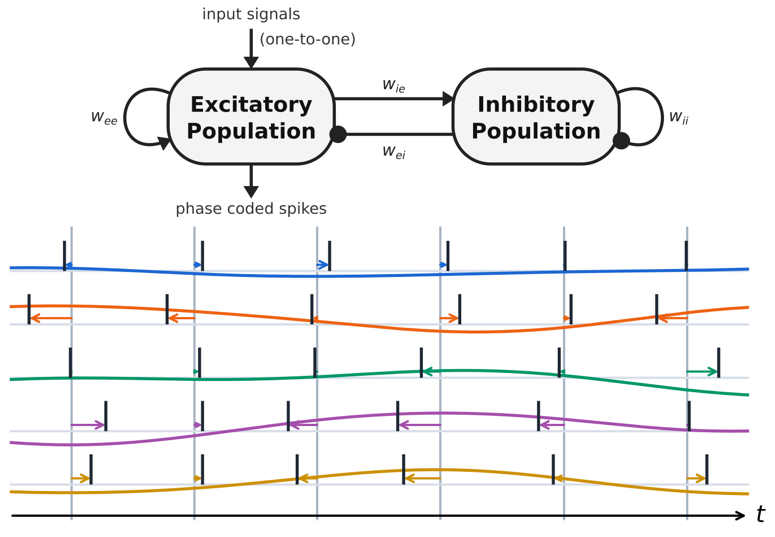
Neuromorphic systems process information using sparse, event-based signals known as spikes, offering an energy-efficient alternative to dense continuous representations. The way continuous signals are converted into spikes strongly influences accuracy, latency, and spike count. Among different encoding strategies, temporal codes exploit the precise timing of spikes, while phase encoding represents information through spike timing relative to an oscillatory reference signal. Recurrent networks of excitatory and inhibitory spiking neurons can naturally generate collective oscillations, providing an intrinsic timing reference for phase encoding. This project investigates self-timed phase encoding implemented on the DYNAP-SE neuromorphic processor. Band-limited signals will be encoded into spike phases relative to the network oscillations, while population averaging will be used to compensate for analog circuit variability and device mismatch. The phase-coded activity will be decoded off-chip to reconstruct the original signal and evaluate the trade-off between reconstruction accuracy, population size, and total spike count. Optionally, the phase-based approach will also be compared with rate encoding on the same hardware.
Methodology
-
Configure excitatory–inhibitory recurrent networks on DYNAP-SE to generate stable population oscillations.
-
Encode band-limited continuous signals into spike phases relative to the oscillatory activity of the network.
-
Apply population-based encoding and averaging to compensate for device mismatch and variability in the analog neuromorphic circuits.
-
Decode the phase-coded spike trains off-chip and reconstruct the original input signals.
-
Evaluate reconstruction accuracy as a function of population size, oscillation properties, and total spike count.
-
Optionally, implement rate-based encoding on the same neuromorphic hardware and compare its accuracy and encoding cost with phase encoding.
Available Material
-
DYNAP-SE mixed-signal neuromorphic hardware.
-
Software tools for configuring and recording activity from DYNAP-SE.
-
Existing recurrent-network configurations and neuromorphic processing frameworks.
-
Reference implementations and literature on spike encoding and population-based computation.
Requirements
-
Python programming.
-
Interest in neuromorphic engineering, spiking neural networks, and signal processing.
-
Basic knowledge of neural networks and/or dynamical systems is beneficial.
Contacts
Patrick Bösch (boeschpa@ini.uzh.ch), Elisa Donati (elisa@ini.uzh.ch)
References
-
Auge, D., Hille, J., Mueller, E., et al. (2021). “A Survey of Encoding Techniques for Signal Processing in Spiking Neural Networks.” Neural Processing Letters, 53, 4693–4710.
-
Moradi, S., Qiao, N., Stefanini, F., & Indiveri, G. (2018). “A scalable multicore architecture with heterogeneous memory structures for dynamic neuromorphic asynchronous processors (DYNAPs).” IEEE Transactions on Biomedical Circuits and Systems, 12(1), 106–122.
-
Zendrikov, D., Solinas, S., & Indiveri, G. (2023). “Brain-inspired methods for achieving robust computation in heterogeneous mixed-signal neuromorphic processing systems.” Neuromorphic Computing and Engineering, 3(3), 034002.