Neural Signal Representations Evaluation for Low-Power Brain–Computer Interfaces (In collaboration with the University of Genova)
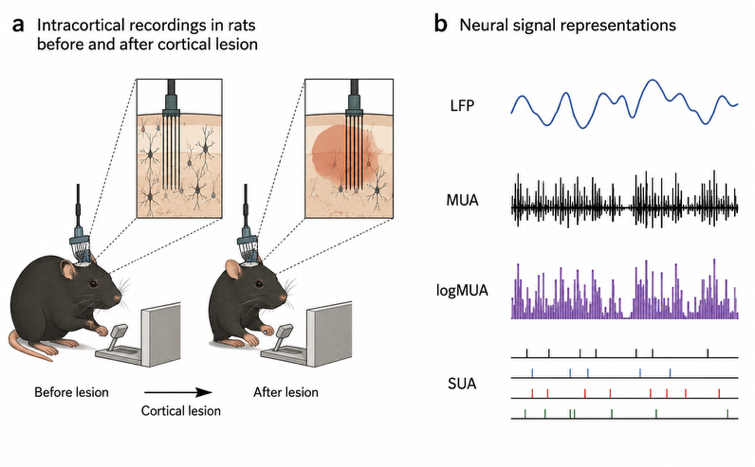
Brain-computer interfaces (BCIs) rely on neural recordings that can be processed at different levels of abstraction, ranging from local field potentials (LFPs) to multi-unit activity (MUA) and spike-sorted single-unit activity (SUA). While spike sorting is often considered the gold standard for extracting neural information, it requires substantial computational resources, memory, and bandwidth, making it difficult to deploy in real-time, low-power implantable systems. Simpler representations, such as thresholded MUA or LFP features, may offer comparable, if not superior, decoding performance while significantly reducing computational complexity. This project aims to determine which neural representation provides the best trade-off between information content and implementation cost. Using intracortical recordings collected from rats performing behavioral tasks before and after a cortical lesion, the same neural activity will be represented as LFPs, MUA, logMUA, and spike-sorted SUA. These representations will be compared from two complementary perspectives. First, the amount of task-relevant information contained in each signal will be quantified using identical neural classifiers. Second, a spiking autoencoder will be used to learn a low-dimensional latent representation of the neural activity, allowing the comparison of neural trajectories across recording modalities and lesion conditions. Finally, the results will be related to practical implementation metrics, including bandwidth, feature dimensionality, network size, and computational complexity, to identify the most efficient neural representation for future low-power and neuromorphic BCIs.
Methodology
-
Extract LFP, MUA, logMUA, and spike-sorted SUA from the same intracortical recordings obtained before and after cortical lesion.
-
Train identical neural classifiers on each representation to quantify the amount of task-relevant information preserved by each signal.
-
Train a spiking autoencoder for each representation and compare the learned latent spaces to analyze neural trajectories and how they change following the lesion.
-
Compare decoding performance, latent-space structure, input bandwidth, feature dimensionality, and network complexity to identify the best trade-off between decoding capability and computational efficiency.
Available Material
-
Rat intracortical recording datasets acquired before and after cortical lesion.
-
Signal processing and spike-sorting pipelines.
-
Neural decoding and spiking autoencoder framework.
Requirements
Contacts
Elisa Donati (elisa@ini.uzh.ch)
References
-
Stevenson, Ian H., and Konrad P. Kording. "How advances in neural recording affect data analysis." Nature neuroscience 14.2 (2011): 139-142.
-
Stavisky, S. D., Kao, J. C., Nuyujukian, P., Ryu, S. I., & Shenoy, K. V. (2015). A high performing brain–machine interface driven by low-frequency local field potentials alone and together with spikes. Journal of neural engineering, 12(3), 036009.
-
Bian, S., Donati, E., & Magno, M. (2024). Evaluation of encoding schemes on ubiquitous sensor signal for spiking neural network. IEEE Sensors Journal, 24(21), 35008-35018.